Partner-supported cases
Observed in context and examined through the artefacts teams used to make work happen.
Bachelor Thesis · Portfolio Case Study · 2026
From problem qualification to a justified Human-AI work system.
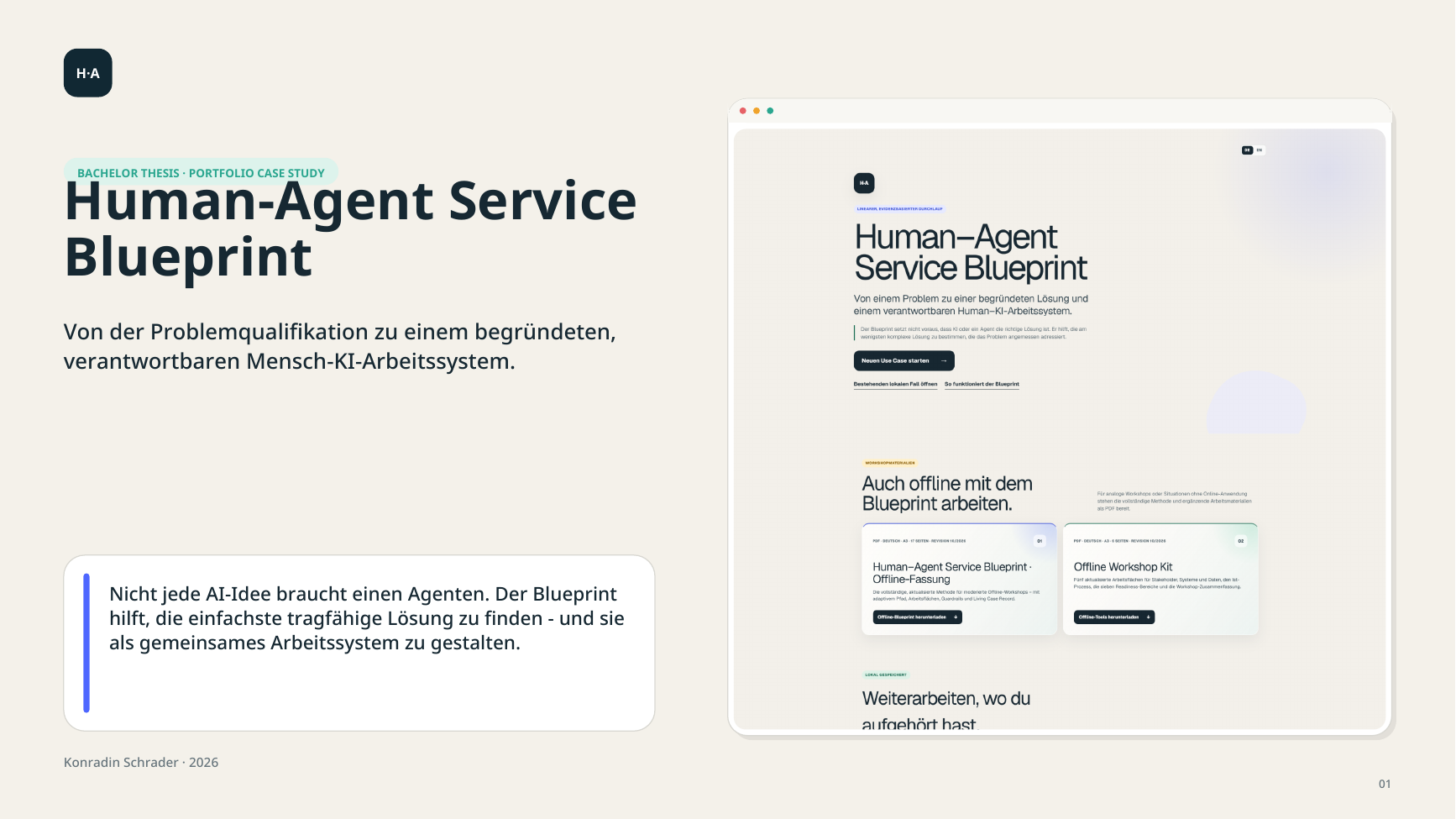
An evidence-based service-design method that helps teams move from a solution-led AI use case to a reasoned decision about task allocation, readiness, architecture, control, integration, and next steps. The result is an interactive web application, an offline workshop kit, and an exportable Decision Snapshot.
01 · The challenge
Many AI projects begin with an assumed solution: “We need an agent.” The research showed that the real bottlenecks often appear earlier—in problem understanding, roles, data access, handoffs, governance, and operational readiness. The Blueprint reverses that logic: qualify first, then shape the simplest system that can reliably do the job.
Not: “How do we build an agent?”
But: “Which form of automation is justified for this work system?”
02 · Research → Design
Six partner-supported project cases formed the research field. Participant observation and artefact analysis were brought together through cross-case thematic analysis and translated into a Design Science artefact.
Observed in context and examined through the artefacts teams used to make work happen.
Participant observation, artefact analysis, and cross-case thematic analysis.
A practical method for turning empirical patterns into reasoned design decisions.
03 · The Blueprint
04 · Digital implementation
A linear macro process keeps the work legible while allowing teams to revisit and correct earlier decisions.
The Living Case Record carries the case state forward; adaptive next steps avoid a rigid completeness checklist.
The Service Canvas synthesises the work system, and a Decision Snapshot exports a portable milestone view.
Glossary guidance and persistent local cases support continued work; an Offline Workshop Kit enables the same method without the web application.
05 · Optional assistance
When asked, the optional AI Copilot reviews the current case, surfaces contradictions or evidence gaps, and proposes concrete additions. Each suggestion is reasoned, shown as a change preview, and applied only after explicit confirmation.
AI recommends evidence explains humans deliberate humans decide.
06 · Outcome
The export brings the current rationale and operating conditions into a portable format, so a decision can travel beyond the workshop or prototype.